
In practice, a hollow rock bolt combines drilling, flushing, grouting, and anchoring in one threaded steel bar. It is used where fractured rock, running ground, weathered shale, gravel, or groundwater can collapse a pre-drilled hole before a conventional bolt is inserted. The hollow rock bolt stays in the borehole as the reinforcing tendon while grout pumped through its hollow core bonds the bar to the surrounding ground. This guide covers its components, load-transfer mechanism, installation, testing, corrosion protection, sizes, and uses in tunnels and mines.
What is a steel hollow rock bolt design?
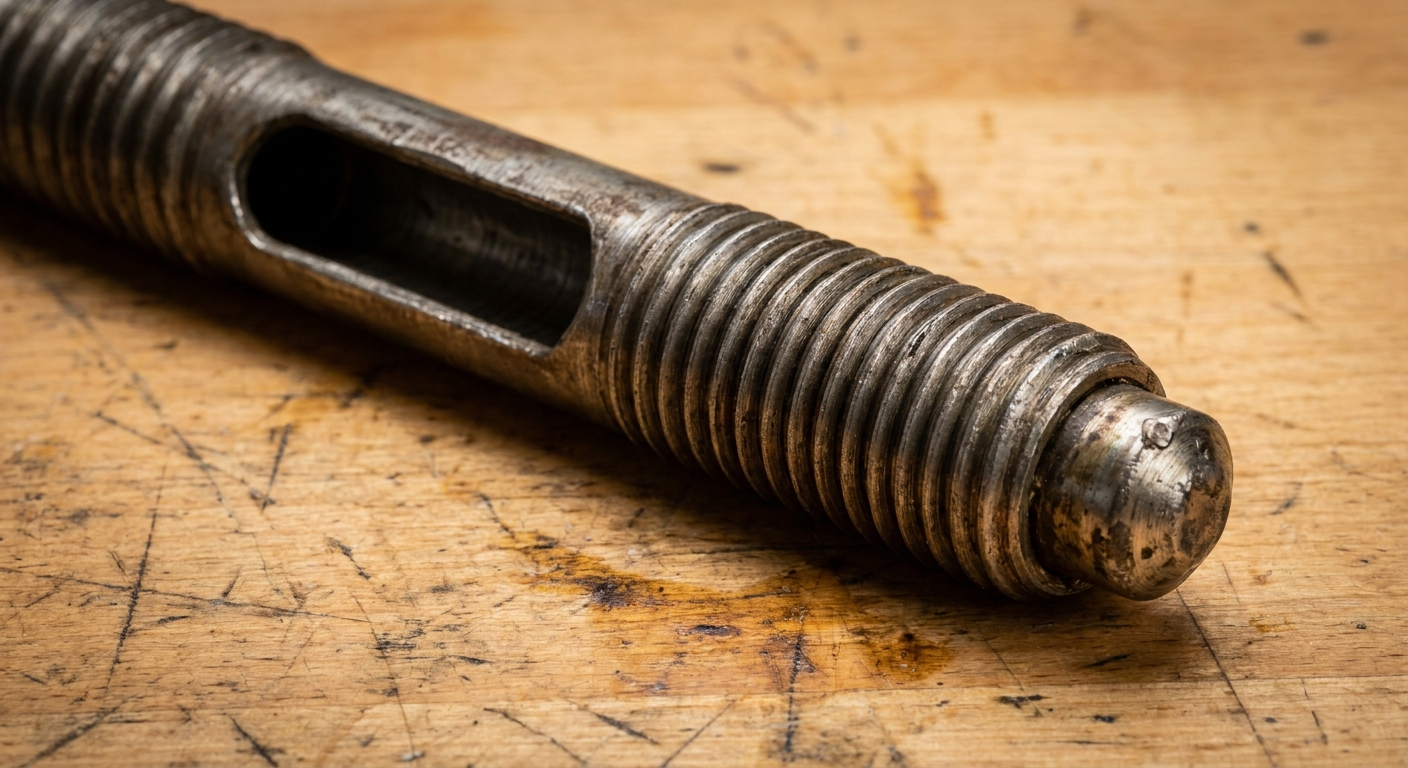
First, a steel hollow rock bolt consists of a threaded hollow bar, sacrificial drill bit, couplers, dome plate, spherical washer, and nut. The bar acts as both drill string and permanent tendon. After drilling reaches the design depth, grout travels through the hollow core and exits at the bit, filling the annulus and nearby fissures before it cures around the steel.
What are the fundamental components of this system?
The system relies on four working components:
- Threaded Hollow Steel Bar: Acts as both the drilling rod during installation and the permanent reinforcing tendon.
- Sacrificial Drill Bit: Mounted on the lead end to cut through rock and remain permanently inside the borehole.
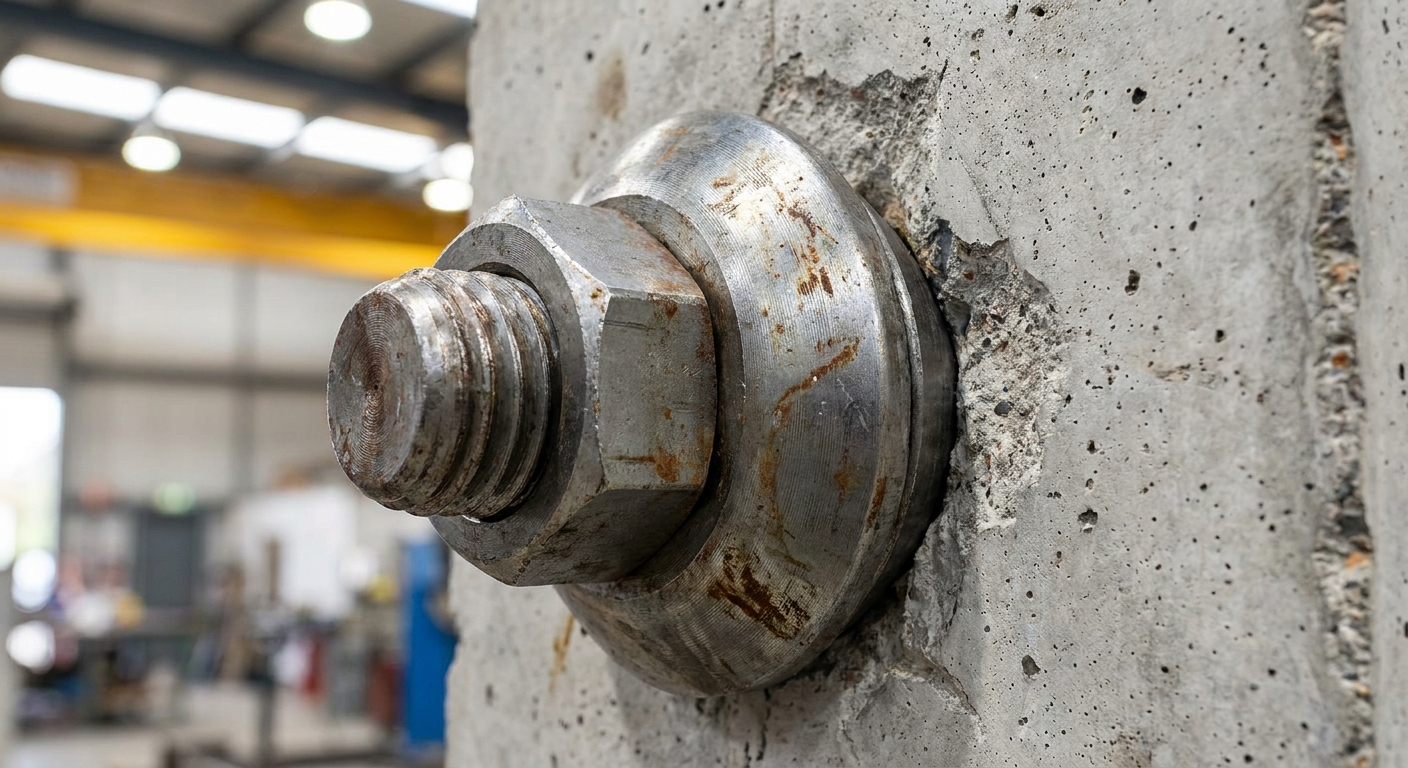
- Dome Plate & Spherical Washer: Evenly distributes structural loads across the uneven rock face.
- Threaded Coupler: Connects multiple steel bars together to achieve deep anchorage lengths when required.
How does the hollow core improve grouting efficiency?
A solid bar needs a stable pre-drilled hole. A hollow bar carries air or water during drilling, then carries cement grout to the toe of the borehole without removing the drill string.
- Bottom-Up Grouting: Grout flows through the central channel and exits from the drill bit to fill the hole completely.
- Void Elimination: Fluid mechanics ensure all air pockets are displaced, preventing rust and maximizing bond strength.
- Mechanical Interlock: Continuous R or T thread profiles bond aggressively with the cured grout column.
- Rapid Execution: Combining drilling and grouting eliminates separate installation cycles and improves workforce safety.
| Component | Core Function | Structural Benefit |
|---|---|---|
| Hollow Bar | Conveyance & Tensile Anchor | Simplifies installation & resists high pulling forces |
| Sacrificial Bit | Rotary-percussive cutting | Allows drilling through collapsing, soft geology |
| Couplers | Sectional extension | Enables deep-seated anchor depths in restricted spaces |
How does a hollow rock bolt secure rock?
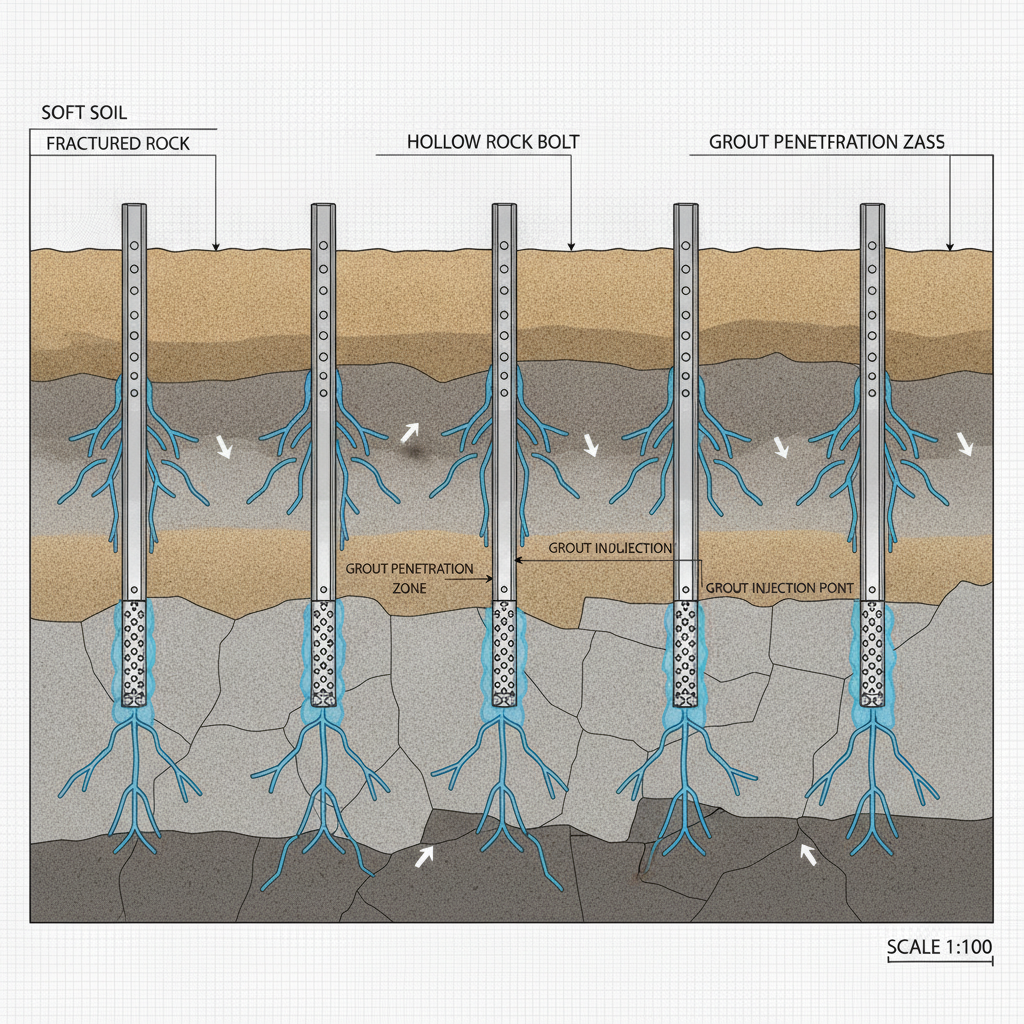
As a result, grout bonds the hollow rock bolt to the full length of the borehole. Shear transfer along the grout-steel and grout-rock interfaces moves load away from fractured outer layers and into competent ground. The bar crosses joints, the plate clamps the excavation surface, and the bonded column limits slip and roof sag.
How does it transfer loads within rock masses?
The system controls rock movement in three ways:
- Friction and Adhesion: Continuous shear stress transfer across the entire grout column eliminates localized stress concentration points.
- Structural Doweling: The steel bar crosses fracture planes to resist lateral shear displacement directly.
- Clamping Action: Tensioning the dome plate compressively pre-loads the superficial rock layers to prevent early loosening.
What are the benefits of simultaneous grouting?
Because the bar remains in place, it supports the borehole throughout drilling and grouting. This is the main advantage in fractured or running ground. See our self-drilling rock bolt installation guide for the full sequence.
- Borehole Preservation: No casing pipes are needed since the bar remains in place.
- Fissure Permeation: Consolidates loose sand and gravel surrounding the anchor zone.
- Increased Pull-out Resistance: Irregular borehole walls created by high-pressure grouting boost mechanical skin friction.
| Mechanics | Traditional Rebar Bolts | Self-Drilling Hollow Bolts |
|---|---|---|
| Installation Method | Two-step (Drill then Insert) | One-step (Simultaneous Drill & Bolt) |
| Borehole Stability | Requires stable pre-drilled holes | Self-supporting during drilling phase |
| Strata Consolidation | Limited to borehole diameter | Expands into surrounding micro-cracks |
When should you use a hollow rock bolt?
Use a hollow rock bolt where weak, fractured, or water-bearing ground will not hold an open borehole. Typical conditions include loose gravel, weathered shale, running sand, active fault zones, tunnel portals, slopes, and deep foundations. In competent rock that holds a clean borehole, a conventional solid or expansion-shell bolt may be simpler.
Is your project facing collapsing ground?
For example, running sand and heavily fractured shale can collapse before a solid rebar bolt is inserted.
- Unconsolidated Gravels: Loose materials shift constantly, making traditional bolt insertion nearly impossible.
- Weathered Shales: Moisture-sensitive clay formations swell and collapse rapidly under standard drilling conditions.
- Active Fault Zones: Highly sheared zones demand immediate support before structural movement compromises safety.
How does high groundwater affect your choice?
In addition, groundwater can wash loose particles from the borehole, dilute grout, and trigger collapse. Choose between a rock bolt and a rock anchor according to the required anchorage length, design load, hydrostatic pressure, and ground model.
- Pressurized Flushing: The hollow design allows continuous air or water flushing to clear out debris.
- Quick-Setting Grout Injection: High-pressure cementitious mixtures seal off water fissures as they cure.
- Hydrostatic Control: The core can act as a drainage channel before final high-pressure grouting is completed.
| Geotechnical Challenge | Primary Failure Risk | Optimized Hollow Bolt Action |
|---|---|---|
| Running Sands & Gravels | Rapid borehole collapse | Simultaneous drilling and structural anchoring |
| High Water Inflow | Grout wash-out & soil piping | Pressurized chemical or neat cement grouting |
| Weathered Clay/Shale | Strata swelling and softening | Dry-air flushing and rapid grout encapsulation |
How is a hollow rock bolt installed safely?
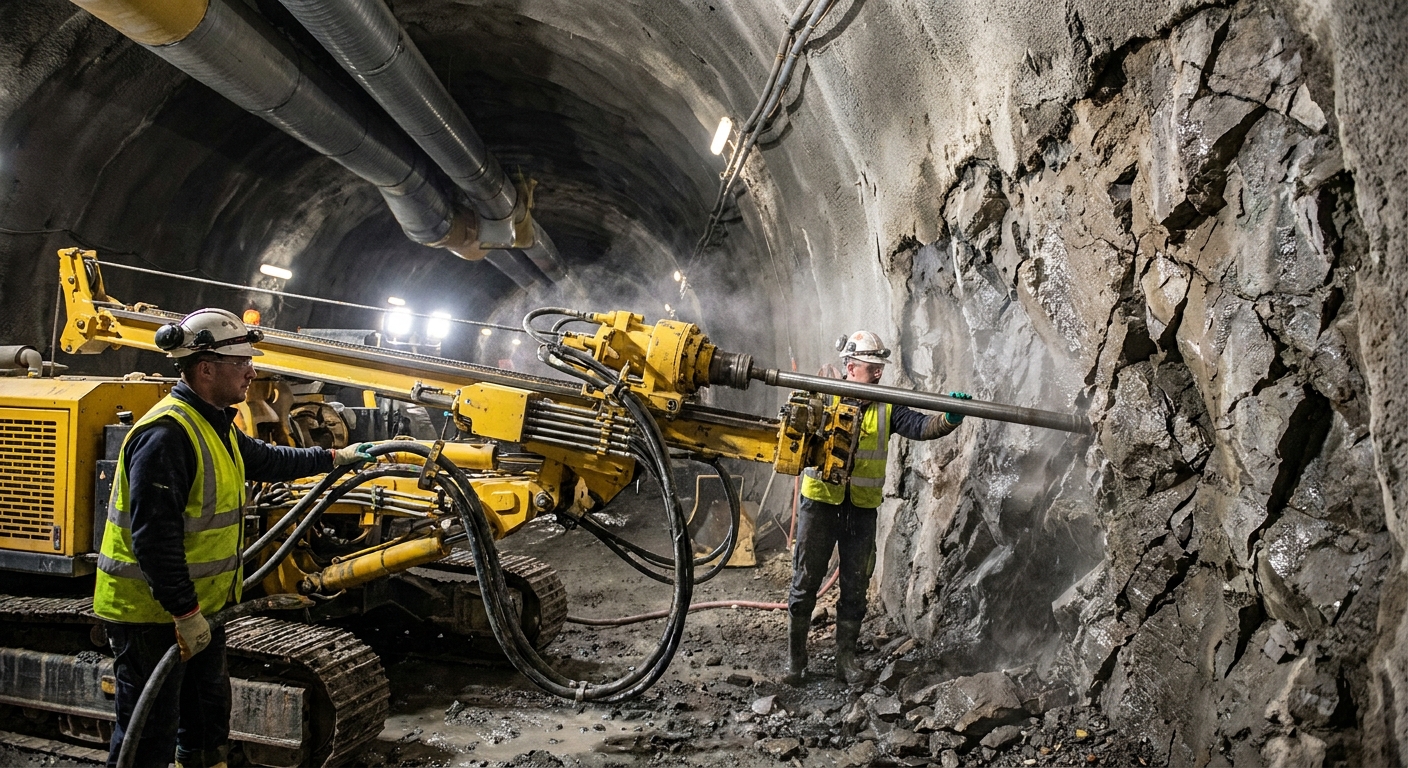
First, crews install a hollow rock bolt in one continuous sequence: attach the sacrificial bit, drill with air or water flushing, extend the bar with couplers when needed, and pump cement grout through the hollow core at the design depth. The bar stays in place as the permanent tendon. The plate, washer, and nut are fitted after the grout reaches the specified strength.
What are the main steps in the drilling phase?
Next, during drilling, control bit selection, alignment, flushing, and coupler make-up:
- Sacrificial Bit Attachment: Selecting a cross or button bit that matches rock hardness is critical.
- Continuous Flushing: Air or water must flow constantly to clean debris from the borehole path.
- Coupler Extension: Couplers join bar segments when the design anchor is longer than the available headroom.
How do you perform the grouting and curing?
Then, at the design depth, pump grout through the bar until return is visible at the collar, then allow it to cure before tensioning. The rock bolt installation guide for mining covers water-cement ratio, pump pressure, curing, and torque checks.
- High-Pressure Injection: Pumping grout at 10 to 20 bar forces slurry into the surrounding rock fissures.
- Curing Protocol: Allowing the cement to cure undisturbed ensures maximum load transfer before tensioning.
- Plate & Nut Securing: Torquing the dome nut completes the installation, locking the structural assembly in place.
| Installation Step | Operational Objective | Quality Control Metric |
|---|---|---|
| Rotary-Percussive Drilling | Penetrate rock to design depth | Continuous flushing and stable penetration rate |
| High-Pressure Grouting | Encapsulate steel bar completely | Grout return visible at the borehole collar |
| Tensioning & Torquing | Apply active compressive load | Calibrated torque wrench verification |
How do you test a hollow rock bolt load?
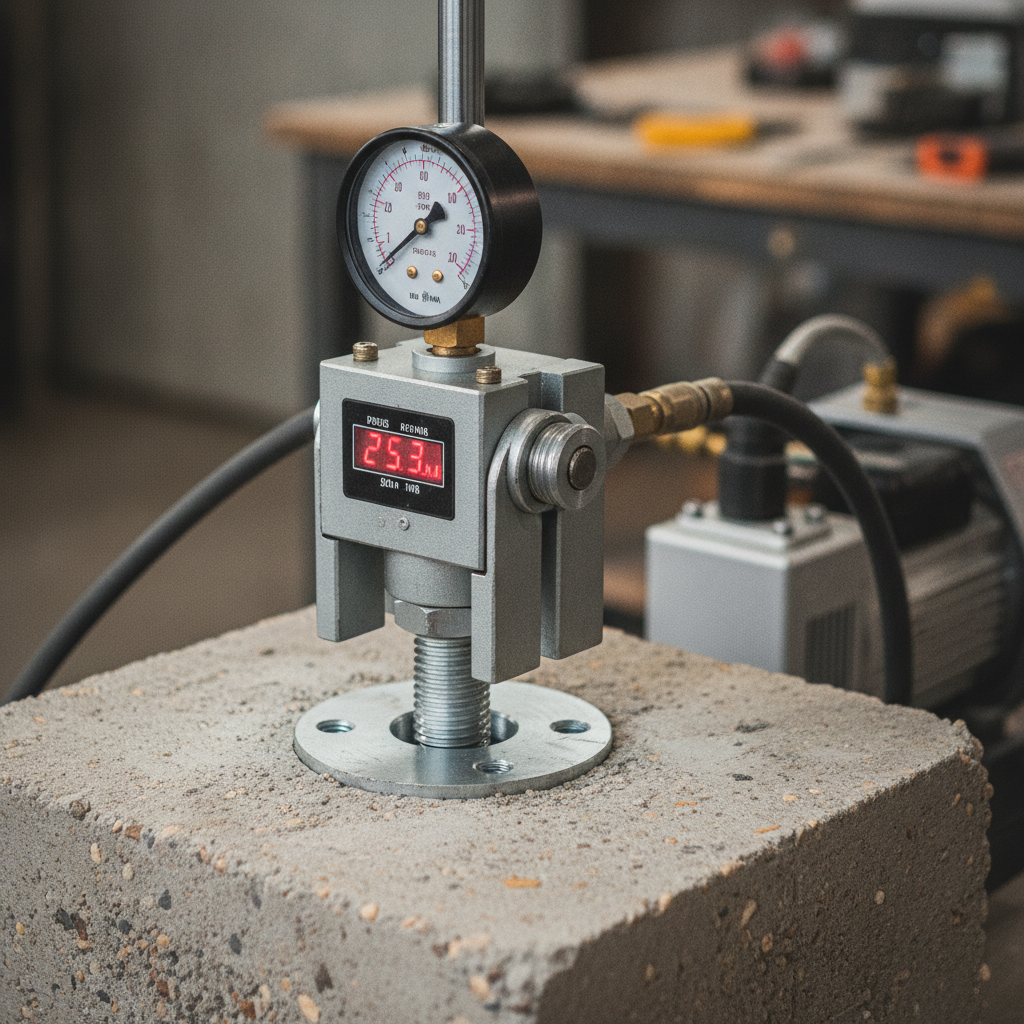
After curing, a hydraulic pull test applies tensile load to the cured anchor in controlled increments and records displacement at each step. A hollow-cylinder jack fits over the exposed bar, a calibrated pressure gauge records load, and a dial indicator measures movement. The load-displacement curve shows whether the steel remains elastic and whether either grout interface slips.
What equipment is required for a pull test?
The test setup requires three calibrated components:
- Hollow-Cylinder Hydraulic Jack: Fits directly over the exposed threaded steel bar to apply axial tension.
- Calibrated Pressure Gauge: Displays precise hydraulic load values in kilonewtons or tons.
- Dial Indicator Gauge: Measures microscopic physical displacement of the bolt during the test.
How do you interpret pull-out test results?
Acceptable results show a linear elastic region, controlled yielding, and no sudden loss of bond. Compare the measured displacement and peak load with the project specification.
- Bond Slippage: A sudden drop in pressure indicates a failure in the grout-rock or grout-steel interface.
- Elastic Deformation: Normal stretching of the steel bar under load confirms a high-quality installation.
- Verification Document: Recording these load-displacement curves provides necessary proof of structural compliance.
| Test Parameter | Acceptable Threshold | Potential Failure Mode |
|---|---|---|
| Ultimate Tensile Load | > 120% of design load limit | Steel bar fracturing |
| Anchor Displacement | Within engineered elastic limits | Grout column slippage |
| System Pressure Hold | Maintains load for 5+ minutes | Hydraulic system leak or rock creep |
Can a hollow rock bolt resist corrosion?
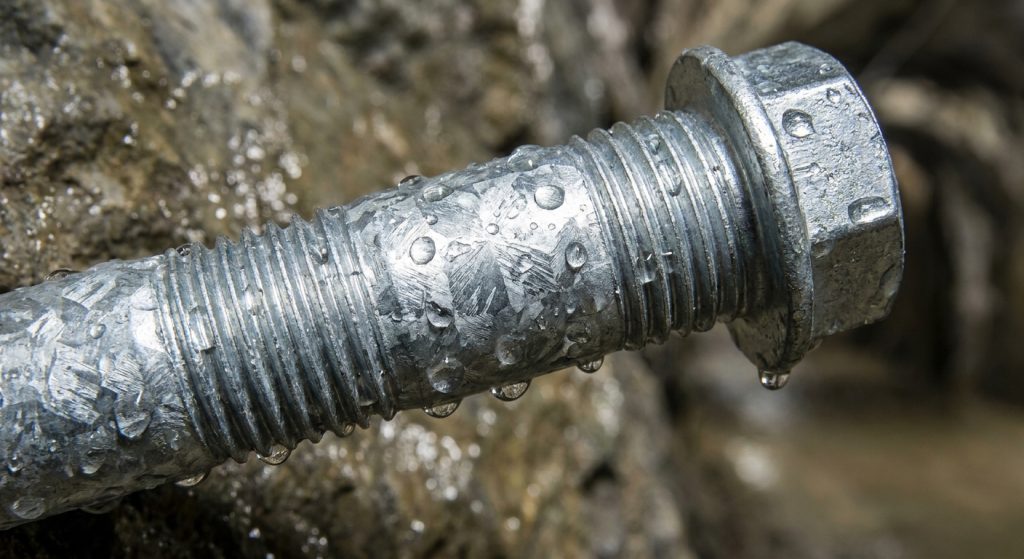
In addition, corrosion protection should match the groundwater chemistry, exposure class, and required service life. Common options include hot-dip galvanizing and a duplex system that adds an epoxy layer over zinc. Full grout encapsulation also limits water and oxygen at the steel surface, but it does not replace the specified coating in aggressive ground.
Why is hot-dip galvanization a reliable shield?
For example, hot-dip galvanizing forms a metallurgically bonded zinc layer. The zinc shields the steel and provides sacrificial protection if the coating is scratched during handling or drilling.
- Sacrificial Action: The outer zinc layer corrodes preferentially to protect any exposed steel surfaces.
- Abrasion Resistance: Zinc-iron alloy layers are extremely tough, surviving the rough drilling process undamaged.
- Full Core Protection: Coating the internal hollow passage prevents internal rust and localized pitting.
What is a duplex coating system?
By contrast, a duplex system combines hot-dip galvanizing with an outer epoxy powder layer. The two barriers are used for permanent anchors exposed to acidic drainage, saline groundwater, or marine conditions. In wet mines, the corrosion plan should also cover nearby conveyor components such as carrying rollers and return idlers.
- Synergistic Longevity: Combining coatings multiplies the service life of the steel anchor by up to three times.
- Acid and Salt Resistance: The polymer layer prevents corrosive ions from attacking the zinc underneath.
- 100+ Year Design Life: Recommended for critical permanent structures like sub-sea road tunnels and dam foundations.
| Coating Technology | Expected Service Life | Best Environmental Suitability |
|---|---|---|
| Black Steel (Uncoated) | Short-term (Temporary support) | Dry, non-corrosive rock; temporary mines |
| Hot-Dip Galvanized | Medium-to-Long term (Permanent) | Wet civil tunnels, moderately corrosive soil |
| Duplex (Epoxy + Zinc) | Ultra-long term (Permanent 100+ years) | Highly acidic mine drainage, marine environments |
What are standard hollow rock bolt sizes?
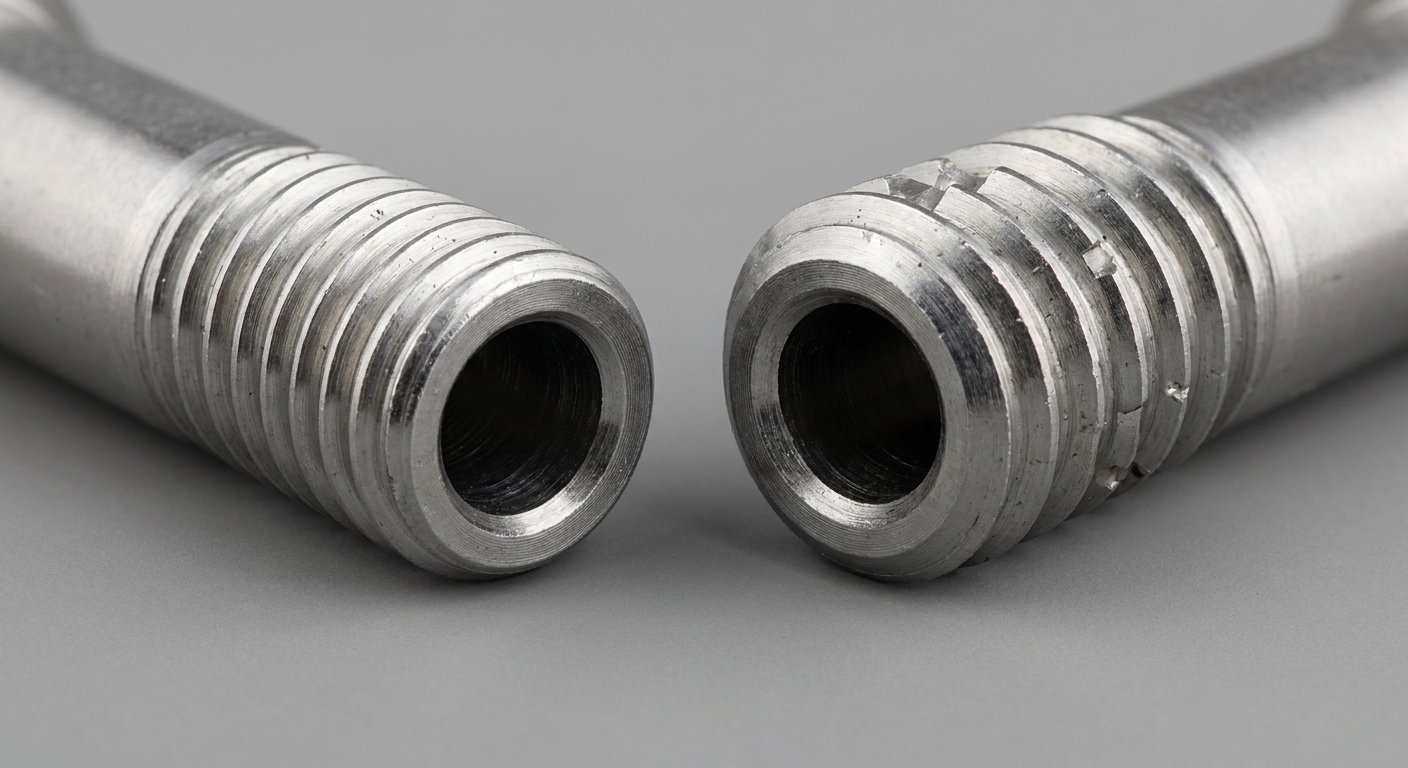
In practice, hollow rock bolt sizes combine bar diameter, thread profile, yield load, and ultimate load. R25 and R32 bars suit lighter soil-nailing and tunnel-support work; R38 and R51 cover heavier excavation and mining loads; T76 and T103 bars are used for high-capacity micropiles and foundation anchors. Use the project load model and drilling equipment to choose the right rock bolt size.
What are the main diameter classifications?
Therefore, select bar diameter from the design load, ground conditions, borehole geometry, available drilling torque, and coupler compatibility.
- R25 & R32 Series: Used for light-to-medium soil nailing, slope stabilization, and secondary tunnel support.
- R38 & R51 Series: The global industry standard for deep civil excavations and heavy mining tunnels.
- T76 & T103 Series: Heavy-duty micro-pile diameters designed to support structural foundations and extreme retaining walls.
What are the differences between R and T threads?
R- and T-thread profiles change coupling behavior, drilling torque, and grout bond:
- R-Thread (Rope Thread): Rounded, shallow wave profile that is easy to couple and uncouple during drilling.
- T-Thread (Trapezoidal): Deeper, flat-crested profile engineered to handle massive rotational torque without stripping.
- Coarse Pitch Benefits: Trapezoidal threads provide a superior mechanical lock with the surrounding grout column.
| Bar Size & Thread | Outer Diameter (mm) | Yield Load (kN) | Primary Geotechnical Use |
|---|---|---|---|
| R32 (Rope Thread) | 32 mm | 220 – 280 kN | Tunneling spiling, slope nailing, mining |
| R51 (Rope Thread) | 51 mm | 630 – 800 kN | Deep rock anchoring, heavy excavation portals |
| T76 (Trapezoidal) | 76 mm | 1200 – 1600 kN | High-capacity foundation micro-piles, dam ties |
Where is a hollow rock bolt used in tunnels?
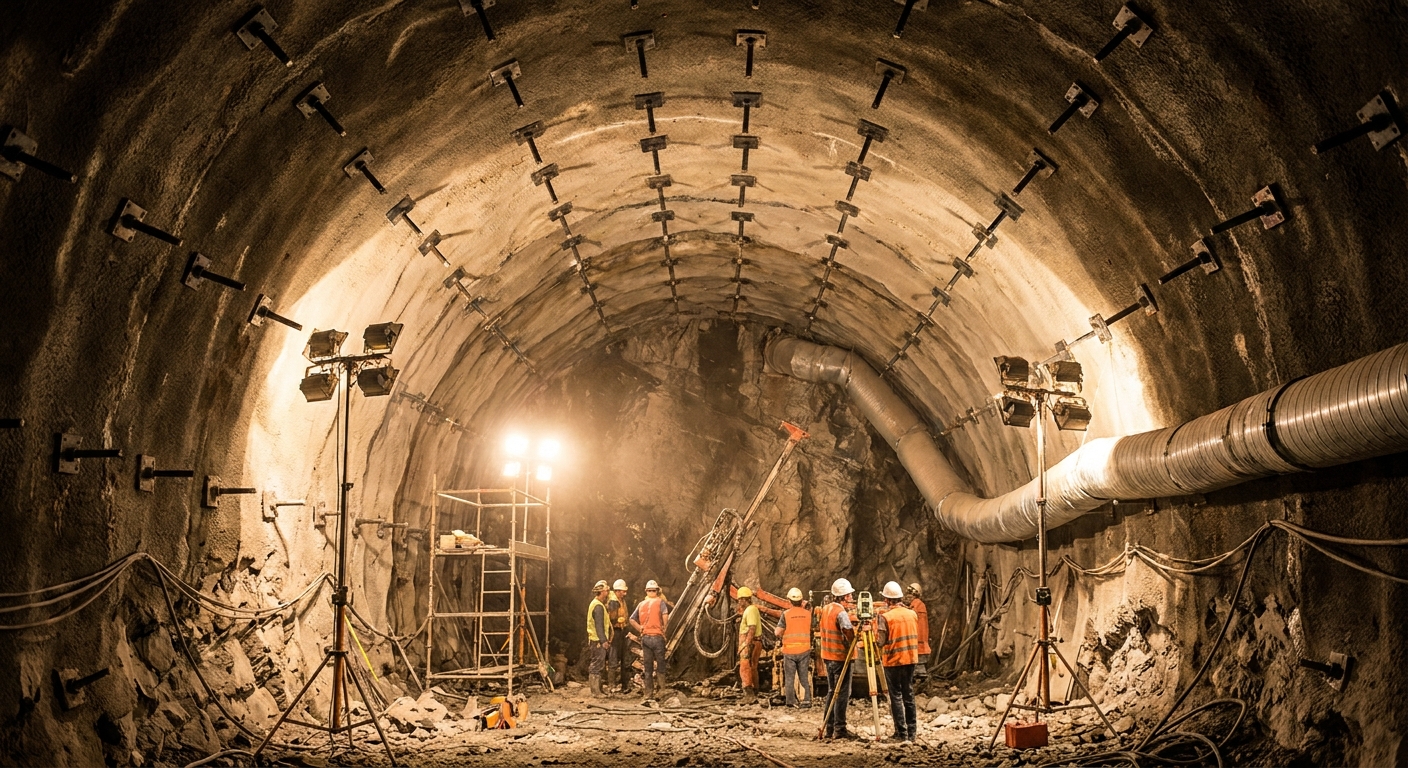
For example, in tunnels, hollow bars stabilize weak portals, reinforce the excavation face, and form pre-support canopies in ground that will not stand open. Crews use them for spiling, forepoling, face bolting, and systematic radial bolting. Grout around the bars consolidates the rock ring and helps control settlement below roads and buildings.
How does it secure weak tunnel portals?
However, at tunnel portals, shallow cover and weathered rock increase the risk of slope movement and crown collapse.
- Umbrella Pipe Arch Support: Hollow bars installed horizontally over the crown create a protective structural canopy.
- Face Stabilization: Injecting grout directly into the excavation face prevents active soil sliding and cave-ins.
- Spiling and Forepoling: Creates an inclined, pre-reinforced roof to bridge weak geological shear zones.
What is its role in high-stress zones?
In addition, deep tunnels can combine high hydrostatic pressure with squeezing ground. Select the tunnel rock bolt configuration from the load model, joint orientation, excavation sequence, and lining design.
- Squeezing Ground Support: Fully bonded hollow bars reinforce the rock ring, helping it resist plastic deformation.
- Shotcrete Integration: Hollow bars work alongside steel wire mesh and sprayed concrete to form a flexible lining.
- Systematic Radial Bolting: Placed in a grid pattern around the tunnel circumference to distribute rock pressures evenly.
| Tunneling Application | Structural Mechanism | Key Operational Benefit |
|---|---|---|
| Forepoling (Spiling) | Creates inclined overhead pre-support | Prevents loose rock from falling into the active excavation face |
| Face Bolting | Pins the active soil face horizontally | Controls forward ground extrusion and surface settlement |
| Systematic Radial Support | Integrates with shotcrete rock arches | Maintains the long-term circular structural integrity of the tunnel |
How are hollow rock bolts used in mining?
Similarly, in underground mines, hollow rock bolts suspend fractured roof layers from competent strata, clamp laminated beds into a thicker beam, and reinforce haulage drifts exposed to changing stress. Fully bonded bars distribute load along the grout column and remain anchored during vibration better than point-anchor systems in broken ground. For broader guidance on roof support and ground-fall control, see NIOSH mining and ground-falls research.
How does it prevent catastrophic roof falls?
Roof bolts control fall risk through three mechanisms:
- Suspension Mechanism: Anchors immediate, fractured roof layers to deep, competent strata above.
- Beam Clamping: Restricts bed separation in laminated geologies to increase structural bending resistance.
- Immediate Load Mobilization: Pressurized grouting ensures the steel bar begins resisting rock movement almost instantly.
Can it reduce long-term operational costs?
By contrast, point-anchor bolts and resin-capsule rock bolts can suit stable rock or rapid installation cycles. Fully grouted hollow bars provide a continuous bond when the borehole is fractured or liable to collapse.
- Fewer Bolt Replacements: High-durability steel and coatings eliminate the need for dangerous re-bolting work.
- Fast Face Advancement: Combining drilling and grouting speeds up the cycle times for underground production crews.
- Infrastructure Protection: Ensuring stable rock ceilings protects costly downstream systems, such as heavy conveyor networks.
| Ground Hazard | Physical Impact on Mine | Hollow Bolt Mitigating Action |
|---|---|---|
| Roof Sagging | Blocks haulage drifts & damages tracks | High-strength clamping of stratified rock beds |
| Rock Bursting | Dynamic ejecting of rock blocks | Fully bonded column distributes sudden stress loads |
| Strata Sliding | Shears support structures and rails | High shear-load steel core resists lateral shifting |
How does a hollow rock bolt compare to others?
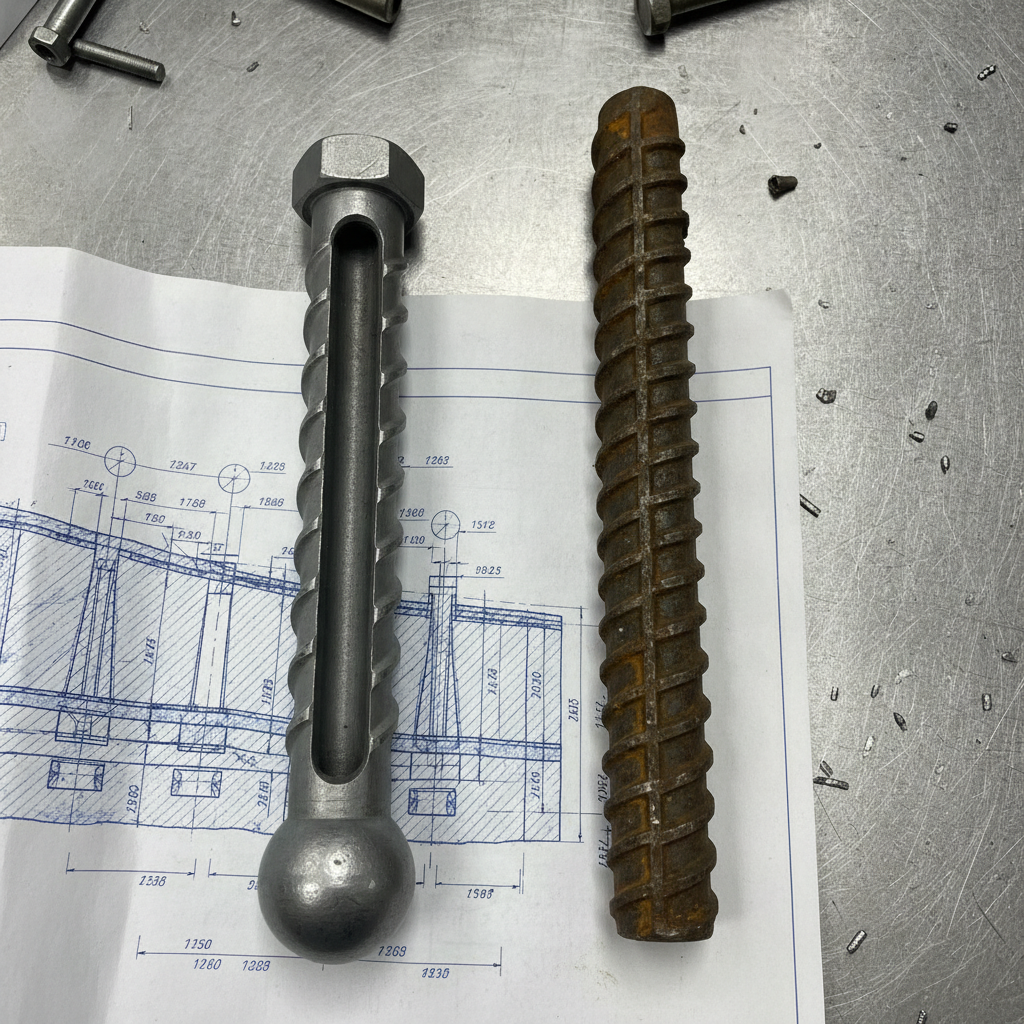
Overall, a hollow rock bolt provides continuous bond without requiring a stable pre-drilled hole. Expansion-shell bolts depend on point anchorage in competent rock; friction bolts provide rapid temporary support; fiberglass bolts are cuttable but carry less shear load than steel. The appropriate system depends on ground quality, required life, installation speed, corrosion exposure, and design load.
How does it differ from expansion shell bolts?
However, expansion-shell bolts install quickly in competent rock, but their point anchorage weakens when the surrounding rock crumbles.
- Point Anchor Weakness: An install an expansion shell rock bolt safely program works only in hard, stable rock zones.
- Continuous Bond Superiority: Hollow bars transfer loads along their entire length, ensuring excellent stability in weak soils.
- Vibration Resistance: Blasting vibrations can loosen expansion shells, whereas grouted hollow bars remain locked.
Why choose it over friction or fiberglass?
In addition, friction bolts provide fast temporary support, while fiberglass bolts are useful where equipment must later cut through the reinforcement. Review how to install a friction rock bolt and install a fiberglass rock bolt before comparing them with a fully grouted steel hollow bar.
- High Tensile Strength: Heavy-duty steel cores withstand far greater overburden pressures.
- Corrosion Resistance: Fully encapsulated grout columns shield the inner steel from aggressive groundwater.
- Ground Compatibility: Performs in soils, gravels, weathered shales, and heavy bedrock.
| Support Bolt Type | Optimal Strata Type | Longevity Rating | Structural Load Capacity |
|---|---|---|---|
| Hollow Rock Bolt | Fractured, weak, soft soils | Permanent (Very High) | Very High (220 to 1600+ kN) |
| Expansion Shell | Hard, competent bedrock | Temporary-to-Permanent | Medium-to-High |
| Friction Bolt | Medium-to-hard rock | Temporary (Low) | Low-to-Medium |
| Fiberglass Bolt | Coal seams, temporary headings | Permanent (High) | Medium (Low shear limit) |
How to specify a hollow rock bolt for your project
Finally, specify a hollow rock bolt from the ground model, design load, drilling method, groundwater, corrosion exposure, and required service life. The system is most useful where an open borehole will not remain stable long enough for a conventional two-step installation.
Yongduo supplies hollow rock bolt components for tunneling, mining, slope stabilization, and foundation work. Send the required bar diameter, thread, anchor length, load, drill-bit type, plate dimensions, and coating specification through our contact page so the engineering team can check component compatibility.
Hollow rock bolt FAQ
Can I use a hollow rock bolt in soft soil?
Yes. Hollow rock bolts are used in soft soil, sand, gravel, and fractured rock where a pre-drilled borehole is unlikely to remain open.
What’s the best coating for highly acidic mines?
For highly acidic mine water, specify a duplex coating that combines hot-dip galvanizing with an outer epoxy barrier. Confirm the final coating against the water chemistry and required design life.
How do I know if my rock bolts require coupling?
In addition, use couplers when the required anchor length exceeds the bar length that the drill rig can handle in the available headroom.
Can I perform a pull test on a wet grout column?
No. Allow the cement grout to reach its specified compressive strength before applying tensile load with a hydraulic jack.
How do I know if a trapezoidal thread is better than a rope thread?
Finally, choose a T-thread when the installation requires higher rotational torque or a deeper mechanical key with grout. Choose an R-thread when faster coupling and easier handling are more important. Confirm the choice against the supplier’s load table and drilling equipment.