
A self-drilling rock bolt combines the drill string, load-bearing tendon, and grout conduit in one permanent element. It is especially useful when a conventional borehole would collapse before a solid bar could be inserted. However, the system only performs as designed when the bar, bit, coupler, grout, drilling method, and verification plan are treated as one engineered assembly.
This guide explains eight practical decisions that improve installation quality without pretending that one detail fits every site. Final bar size, spacing, drilling energy, grout mix, corrosion protection, and test loads must come from the project specification and a qualified geotechnical designer.
1. Confirm when a self-drilling rock bolt is appropriate
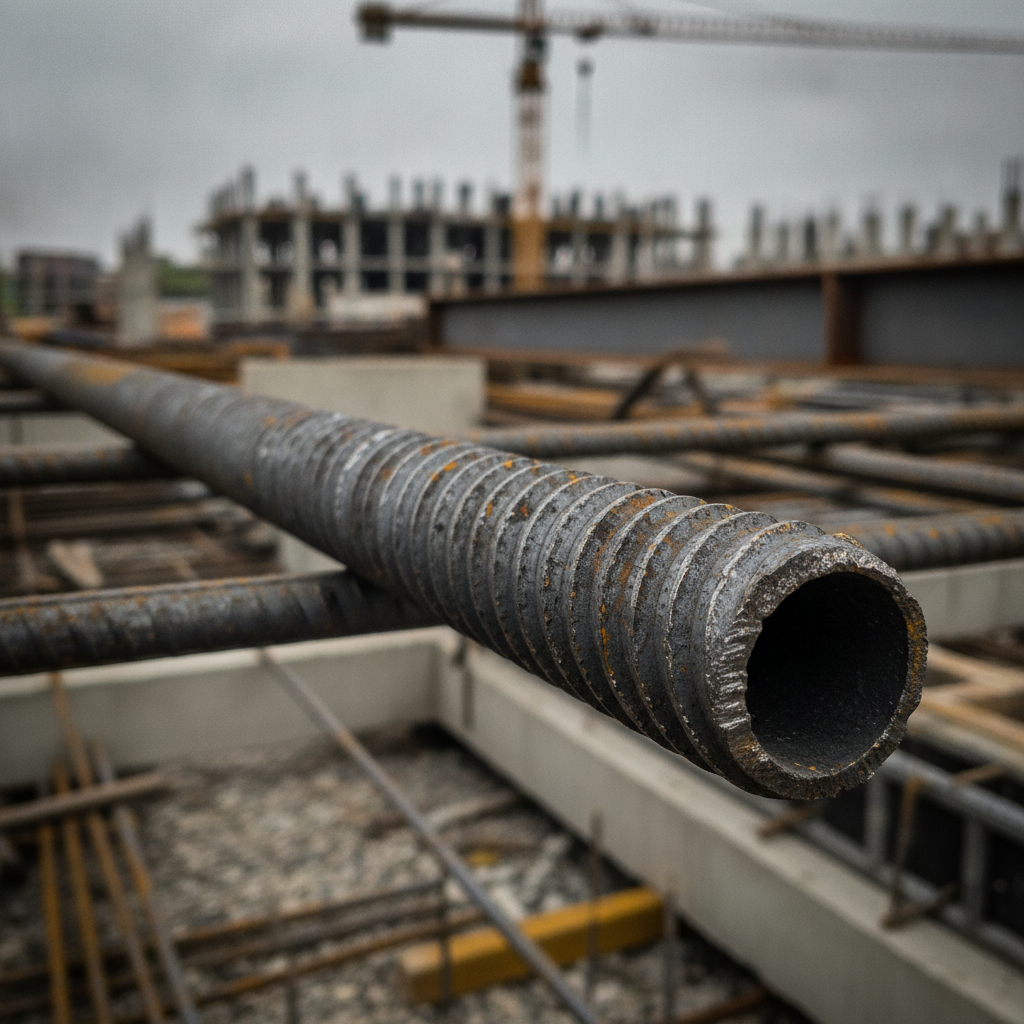
Start with the ground, not the product catalogue. A self-drilling rock bolt is most useful in loose fill, weathered rock, fractured zones, or water-sensitive material where an unsupported hole is difficult to keep open. The sacrificial bit remains in the ground, so the crew does not withdraw a separate drill string before placing the tendon.
The system may be unnecessary in competent rock that holds a clean borehole and accepts a conventional grouted or resin bolt. In that setting, a solid bar may be simpler and more economical. The Federal Highway Administration’s hollow-bar guidance makes the same basic distinction: hollow bars are an alternative when solid-bar installation would otherwise require casing.
| Site condition | Conventional solid bar | Self-drilling hollow bar |
|---|---|---|
| Stable, open borehole | Often suitable | Possible, but may add cost |
| Collapsing or highly fractured ground | May require casing | Often well suited |
| Restricted access | Depends on insertion length | Sectional bars can be coupled |
| Aggressive groundwater | Requires a project-specific durability assessment | |
2. Match every self-drilling rock bolt component
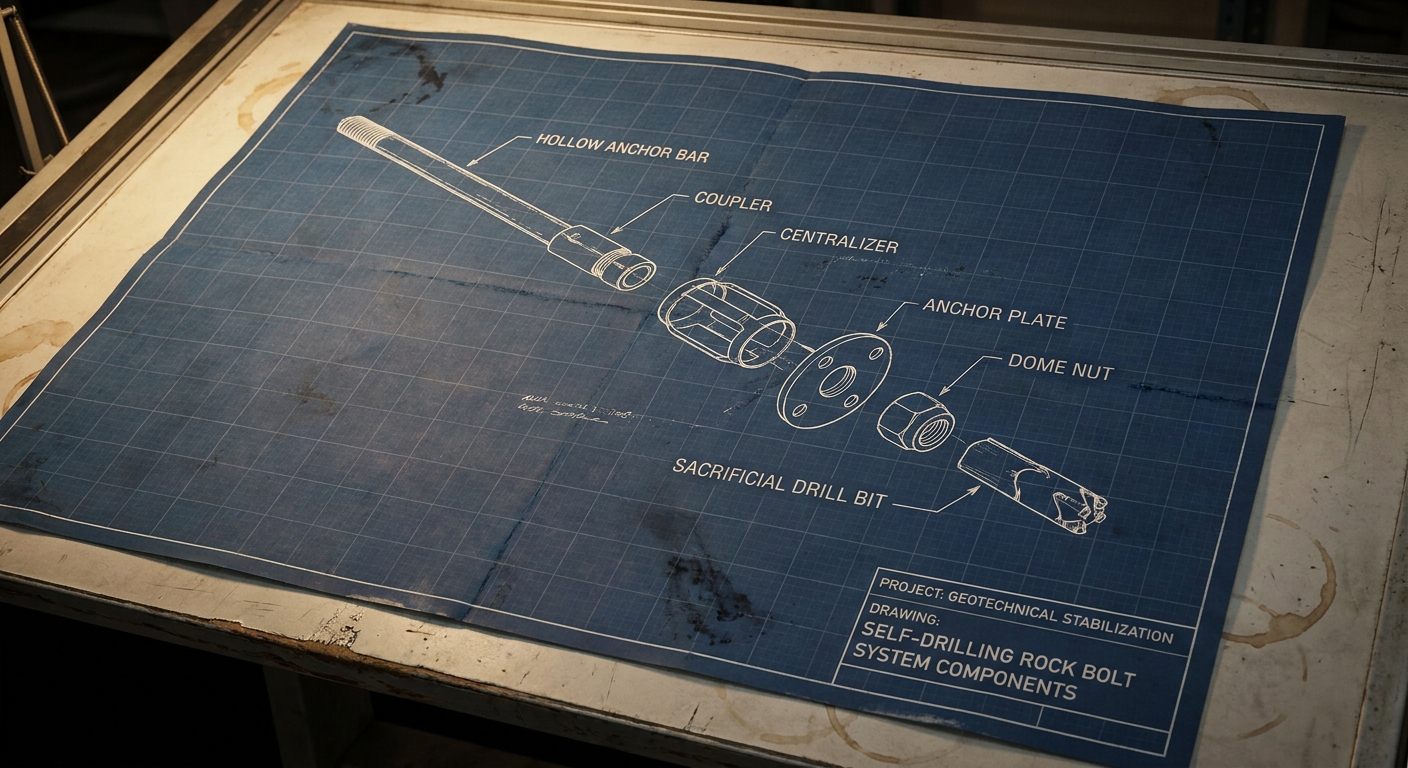
A typical assembly includes a hollow threaded bar, sacrificial drill bit, couplers, centralizers where specified, a bearing plate, and a nut. Each component affects installation as well as structural performance. A coupler that does not transfer the required torque or tensile load can become the weak point, while an undersized plate can crush weak surface material before the tendon reaches its design resistance.
Use components covered by the same technical approval or supported by documented compatibility data. The European Organisation for Technical Assessment database lists the assessment document for self-drilling rock and soil nail kits. It treats the product as a kit rather than a collection of interchangeable parts.
- Check bar and coupler thread engagement before loading the rig.
- Confirm that the bit provides enough annular space for grout return.
- Use the specified plate geometry on uneven or shotcreted faces.
- Keep grout ports and couplers clean during storage and handling.
3. Select the bit from actual ground conditions
Bit selection influences penetration, flushing, deviation, and wear. Wide or stepped blades can move cohesive soil, while button or carbide-equipped bits can work in harder, abrasive material. Those are starting categories, not a substitute for a trial installation. Mixed ground may demand a compromise between aggressive cutting and reliable grout return.
Before production begins, record penetration rate, flushing pressure, spoil return, torque response, and visible bit wear from the trial. If the bar repeatedly stalls, wanders, or blocks, changing only the pump pressure is unlikely to solve the underlying mismatch.
4. Control alignment and drilling records
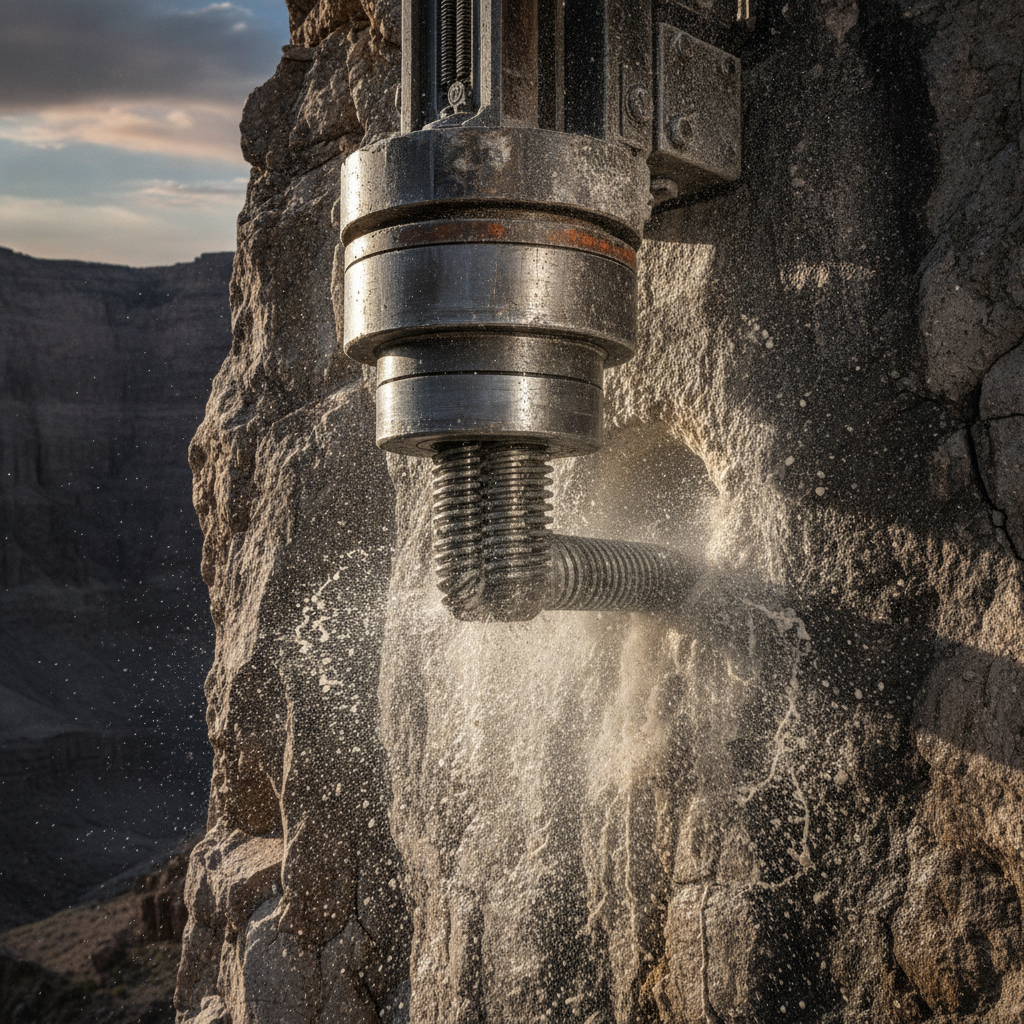
Set the mast to the specified inclination and support the first bar section before applying full rotation or percussion. Misalignment at the collar can bend the bar, damage threads, and create an irregular annulus. Add sections only after cleaning and checking both mating threads; then tighten the coupler using the approved procedure.
Log more than final depth. Useful records include start and finish time, bar sections, coupler locations, penetration changes, fluid or grout pressure, flow, returns at the collar, interruptions, and unusual ground response. A Northern Ireland public-works specification for self-drilling hollow-bar micropiles calls for maintaining drilling flush and, unless otherwise agreed, recording flow and pressure during drilling and grouting.
5. Treat grouting as a controlled operation
Grout provides bond, fills the annulus, and can contribute to corrosion protection. Its proportions and acceptance criteria belong in the approved mix design. Avoid copying a water-cement ratio from another project: pumpability, cement type, groundwater, temperature, required strength, and equipment all affect the suitable range.
Measure materials rather than estimating them by volume. Record batch time, constituents, mix proportions, temperature where required, and any test specimens. During final grouting, continue until the specified return condition is observed at the collar. If circulation is lost, document the volume and response instead of assuming that the annulus is full.
| Control point | What to record | Why it matters |
|---|---|---|
| Batch | Materials, proportions, mix time | Traceability |
| Injection | Pressure, flow, volume, interruptions | Evidence of placement |
| Return | Appearance and time at collar | Annulus continuity check |
| Verification | Specified strength or fluidity tests | Acceptance against the project plan |
6. Design spacing instead of using a rule of thumb
No universal spacing applies to every self-drilling rock bolt layout. The designer must consider rock-mass structure, soil strength, groundwater, excavation sequence, facing stiffness, bar capacity, bond resistance, load combinations, and the consequences of a local failure. A neat grid is not proof of an adequate design.
The FHWA Soil Nail Walls Reference Manual provides a detailed design and construction framework, including specific requirements for fully threaded hollow-bar soil nails, centralization, grout flow, corrosion protection, testing, and records. Use it as a reference, then follow the governing code and project specification.
7. Plan durability for the required service life
Temporary mine support and permanent civil works do not have the same durability demands. Assess groundwater chemistry, soil or rock resistivity where relevant, stray-current exposure, cracks, grout cover, steel loss allowance, coatings, and inspectability. Couplers and exposed head assemblies deserve the same attention as the bar.
Do not assume grout alone always provides sufficient protection. The approved system may require galvanizing, a sacrificial steel allowance, encapsulation, or another barrier. Document damage to coatings during handling and replace components that no longer meet the specified condition.
8. Verify the self-drilling rock bolt installation
A verification plan should define trial installations, sacrificial tests, production proof tests, acceptance criteria, test frequency, equipment calibration, and corrective action. These values must be selected before testing begins. A result cannot be judged fairly against criteria invented after the curve is seen.
Use an aligned reaction arrangement, calibrated force measurement, and an independent displacement reference. Plot load against movement and record the hold periods specified by the design. The U.S. Army Corps of Engineers rock-reinforcement manual discusses rock reinforcement design, installation, testing, and field records in one engineering framework.
For related site controls, see our rock bolt installation procedure and our guide to rock bolts versus rock anchors. These internal references help separate product selection from the project-specific design and testing decisions covered here.
Self-drilling rock bolt site checklist
- Confirm that the ground and borehole behavior justify a self-drilling system.
- Approve one compatible bar, bit, coupler, plate, nut, and grout system.
- Complete and document trial installations before production.
- Control alignment, coupling, flushing, and grout returns for every bar.
- Record materials, depths, pressures, flows, interruptions, and test results.
- Apply the specified durability measures and protect them during handling.
- Test against acceptance criteria written into the quality plan.
- Investigate failed or anomalous results before continuing adjacent work.
Frequently asked questions
Can a self-drilling rock bolt be removed and reused?
No. The bar and sacrificial bit remain bonded in the ground as permanent parts of the installed system. Reuse would destroy the verified bond and installation record.
Is cement grout always injected while drilling?
Not always. Some methods drill with air, water, or a preliminary flush before final structural grouting. The sequence depends on ground behavior, environmental controls, equipment, and the approved method statement.
How do I choose the correct hollow-bar size?
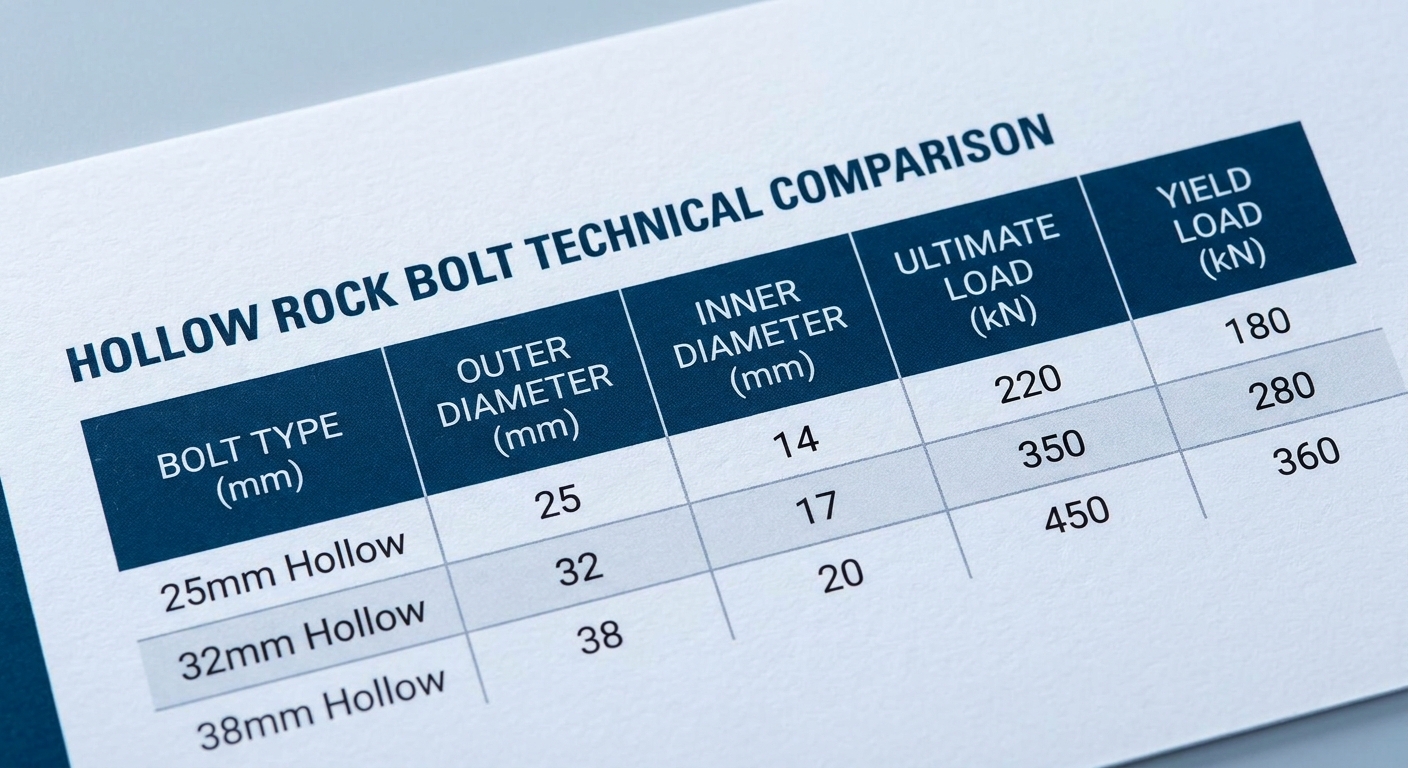
Select it from the design actions, steel capacity, required bond length, installation torque, coupler capacity, corrosion allowance, and approved system data. Bar diameter alone does not establish the installed capacity.
What should happen after a failed proof test?
Quarantine the result, check the equipment and setup, review drilling and grouting records, and follow the corrective-action plan approved by the engineer. Do not simply increase the load or replace one bar without investigating the cause.
Need a manufacturing review for a specified hollow-bar assembly? Send Yongduo Roller your drawings, load requirements, and applicable approval documents so the component list can be checked before quotation.