
The main rock bolt types differ in how they develop load: mechanical bolts grip at a point, friction stabilizers press against the borehole wall, grouted bars bond along their length, and yielding bolts accommodate controlled movement. Rock anchors usually serve a different purpose. They carry concentrated tensile loads through a defined free length into a deeper fixed length, often with deliberate prestressing.
The right choice depends on the failure mechanism, ground behavior, design life, water and corrosion exposure, installation access, and the level of verification the project requires. This guide uses eight practical checks to compare rock bolt types without reducing ground support to a product-name contest.
1. Separate rock bolt types from rock anchors
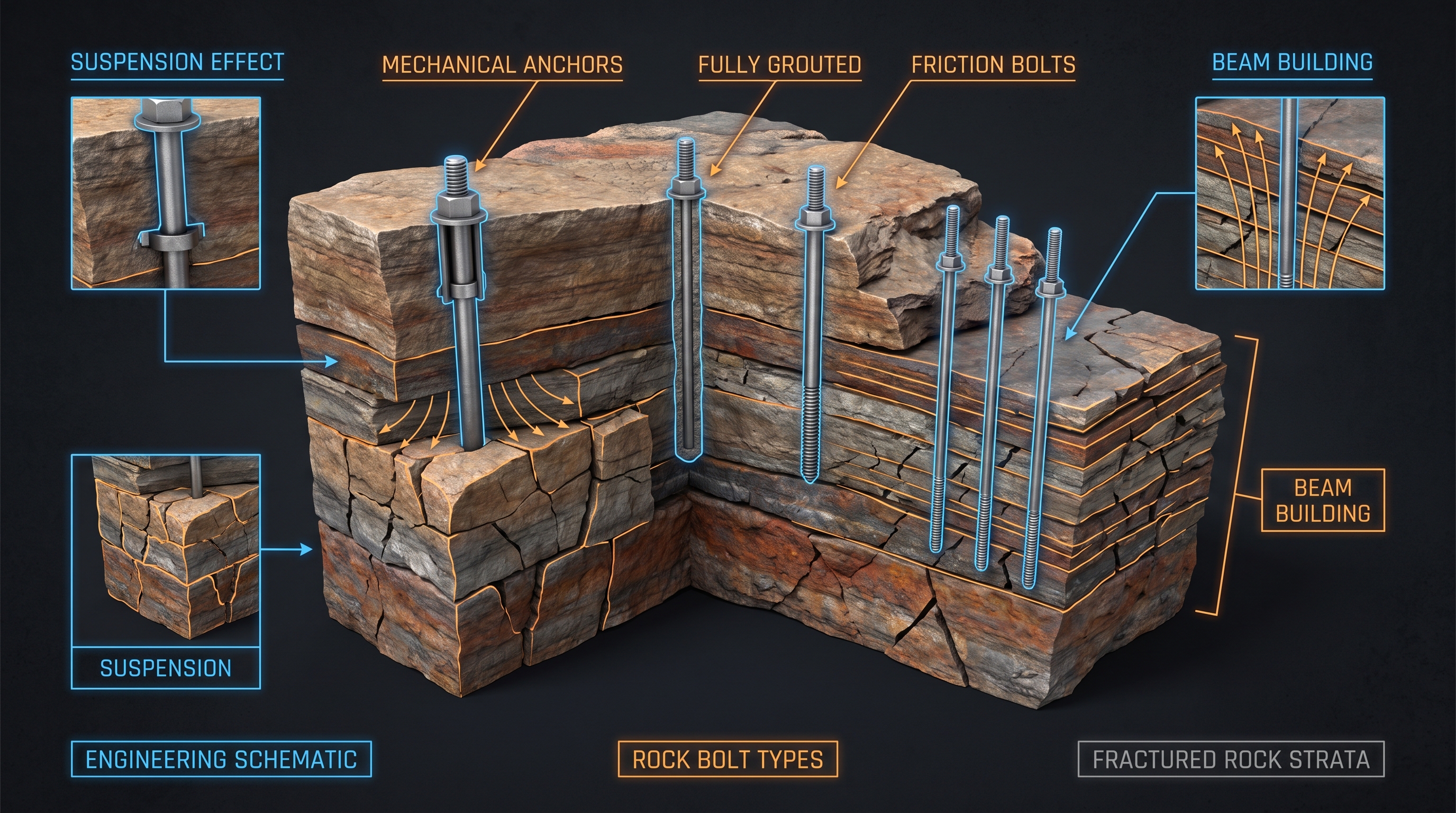
A rock bolt usually reinforces the ground close to an excavation. It limits separation across joints, builds a reinforced zone, or suspends weaker layers from stronger rock. A rock anchor more often includes a free stressing length and a bonded fixed length so that a wall, foundation, or other structure can be prestressed against the ground.
Terminology varies by region and sector, so the name alone is not enough. Review the load path, bonded length, stressing procedure, acceptance test, and service-life requirement. The FHWA Ground Anchors and Anchored Systems manual explains the free-length/fixed-length concept and the performance, proof, and creep tests used for prestressed anchors.
| Design question | Rock bolt | Rock anchor |
|---|---|---|
| Primary role | Reinforce a local rock mass | Transfer a structural tensile load |
| Typical load development | Point, friction, or full-length bond | Prestress through a free length to a fixed length |
| Selection basis | Ground-support interaction | Structural load and geotechnical bond |
| Verification | Project-specific pull or monitoring plan | Specified performance, proof, and sometimes creep testing |
2. Compare mechanical rock bolt types
Mechanical expansion bolts use a shell or wedge that expands near the back of the hole. They can provide immediate support and can be tensioned soon after installation. However, their performance depends heavily on borehole diameter, rock strength at the anchor point, seating, torque control, and the condition of the shell.
They are not a universal choice for weak, crushed, or highly variable ground because a short anchorage zone may not develop reliable resistance. Where mechanical bolts are used, the quality plan should cover drill-bit wear, hole diameter, installation torque, plate seating, and any required pull checks.
3. Understand friction rock bolt types
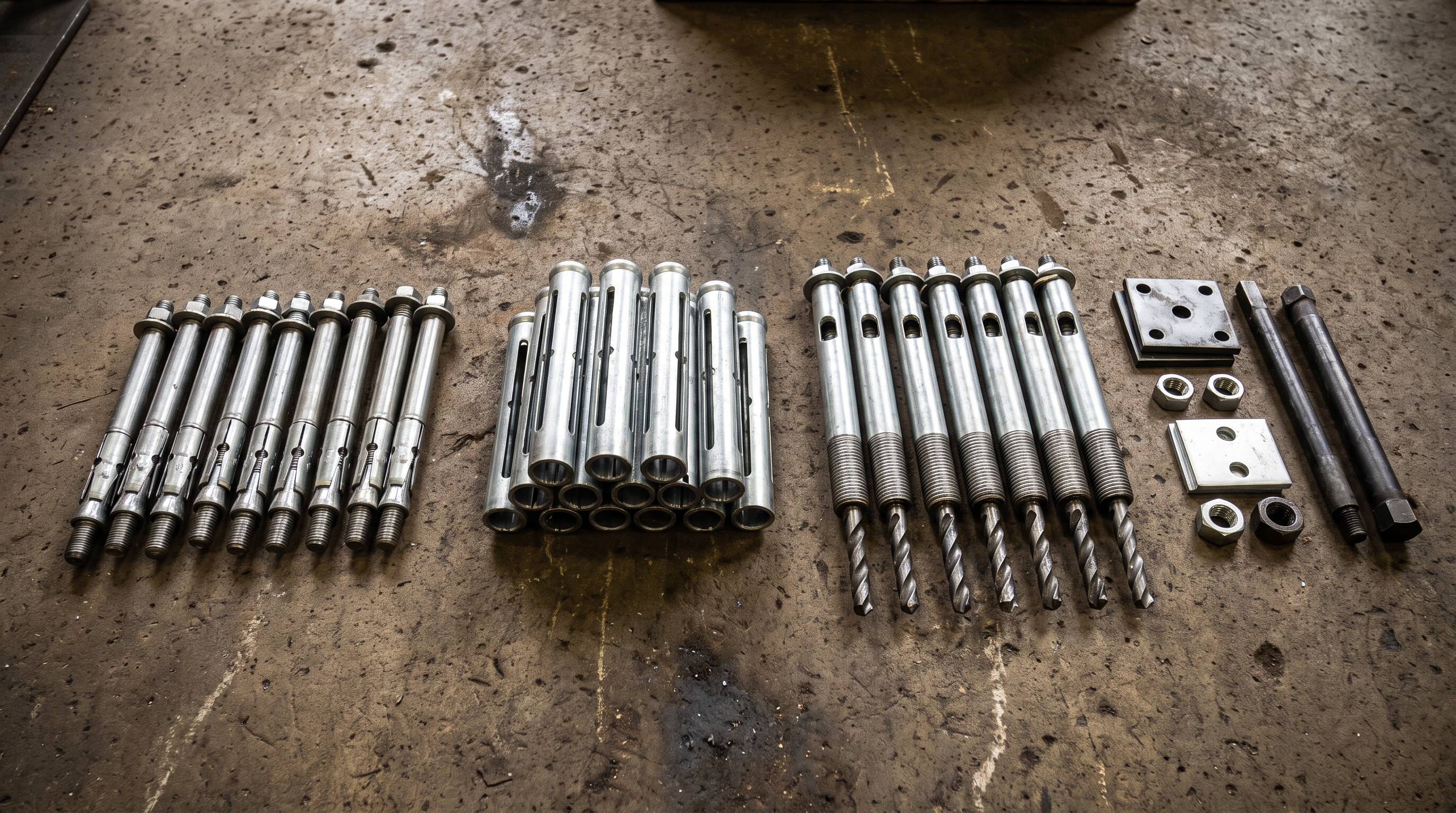
Friction stabilizers develop radial contact with the borehole over much of their length. Split-set bolts are driven into an undersized hole, while inflatable systems expand against the wall using installation pressure. Both can provide rapid support, but their capacity depends on a tightly controlled relationship between the hole, the steel element, and the ground.
These bolts can suit fast development headings and ground that may move, yet they need appropriate corrosion and life-cycle review. A hole that is too large reduces contact; a hole that is too small can damage the bolt or stop it before design depth. Our split-set bolt overview covers the component geometry, while the project engineer must define the acceptance limits.
4. Choose between resin and cement-grouted bolts
Resin-grouted bolts use cartridges that mix as the bar rotates through them. A fast-setting portion can support early tensioning, while slower resin can encapsulate more of the bar. Installation quality depends on the hole diameter, capsule diameter and length, storage condition, temperature, insertion order, spin time, hold time, and the manufacturer’s approved procedure.
Cement-grouted bars are placed in a drilled hole and bonded with a pumpable grout. They can provide full-length support and a durable load-transfer medium when mixing, placement, centralization, and curing are controlled. Neither system is automatically superior; the correct choice follows from the design, construction sequence, water conditions, and required time to load.
| Rock bolt type | How resistance develops | Key field controls | Common use case |
|---|---|---|---|
| Mechanical expansion | Localized shell or wedge | Hole size, rock at anchor point, torque | Immediate support in suitable competent rock |
| Friction stabilizer | Contact along the borehole | Hole diameter, insertion depth, steel condition | Rapid development support |
| Resin-grouted bar | Bond through mixed resin | Cartridge condition, spin and hold times | Fast bonded support |
| Cement-grouted bar | Cementitious bond | Mix, placement, centralization, cure | Full-length support and permanent works |
| Self-drilling hollow bar | Grouted annulus around a permanent drill string | Compatible kit, flushing, grout return | Unstable or collapsing boreholes |
5. Use self-drilling and yielding rock bolt types selectively
A self-drilling hollow bar combines drilling, tendon placement, and a grout path. It can simplify installation in ground that will not hold an open hole. The FHWA Soil Nail Walls Reference Manual describes fully threaded hollow-bar soil nails and the need for grout to flow freely around a centralized bar. Read our detailed self-drilling anchor guide for the associated bits, couplers, plates, grouting, and testing controls.
Yielding bolts are designed for ground that can impose significant deformation or dynamic demand. Instead of assuming that more stiffness is always safer, the designer matches the bolt’s load-displacement response to the expected movement. Energy absorption, elongation capacity, connection behavior, and installation quality all matter; a generic “dynamic bolt” label does not establish suitability.
6. Match rock bolt types to the failure mechanism
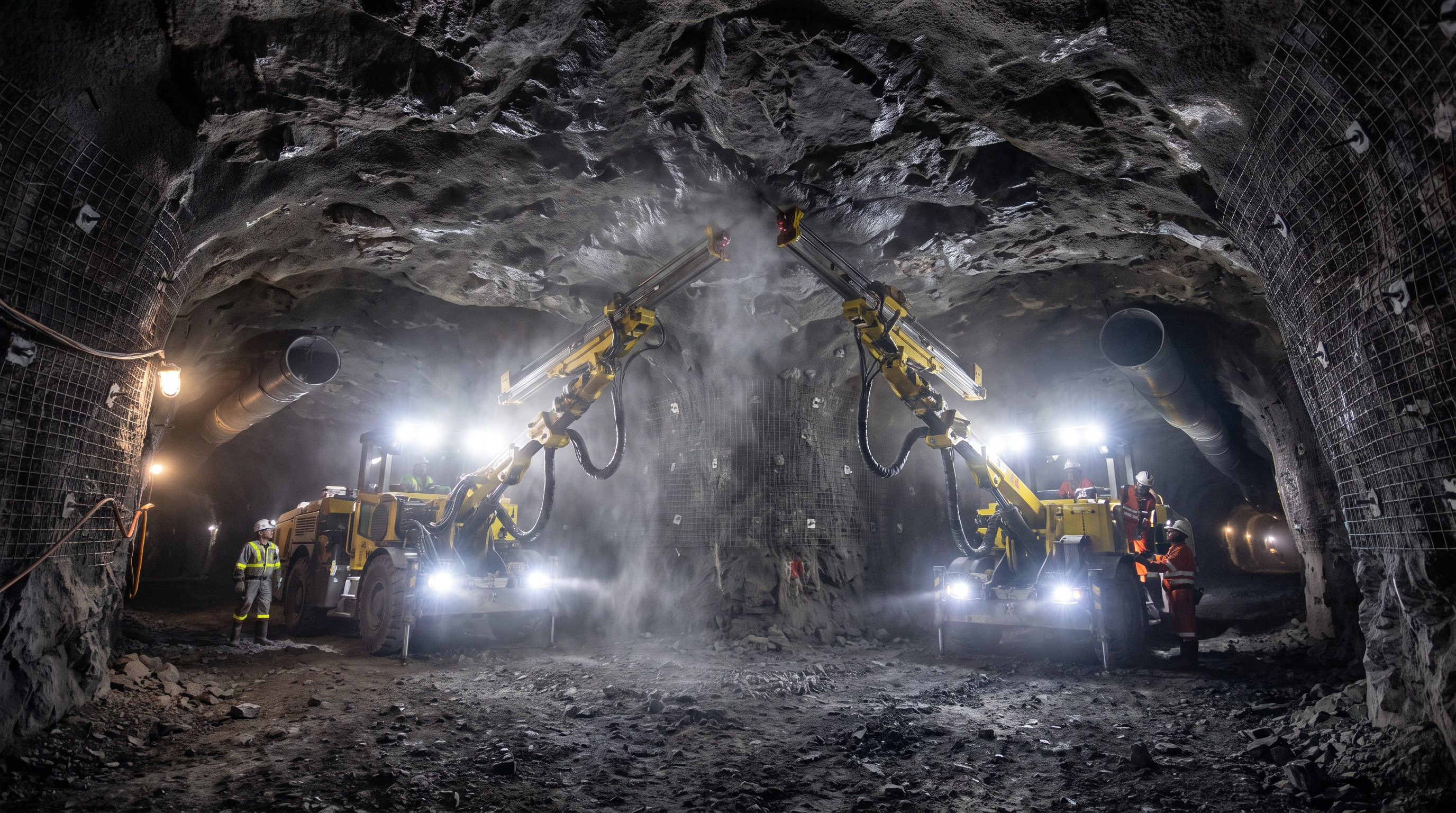
Begin with mapped joints, bedding, faults, weak layers, groundwater, stress orientation, excavation geometry, blast damage, and expected deformation. Then define what the support must do. Suspension, beam building, block keying, confinement, surface retention, and energy absorption require different bolt and facing behavior.
Bolts alone do not catch every loose fragment between support points. Plates, mesh, straps, shotcrete, or other surface systems may be required. NIOSH reports that ground falls remain a major mining hazard and describes roof-bolt design tools, classification methods, monitoring, and surface-control research. Its separate roof-screen work shows why skin control complements bolting rather than competing with it.
- Layer separation: consider support that clamps or suspends the affected strata.
- Jointed blocks: orient and bond bolts to cross the controlling discontinuities.
- Squeezing ground: assess yielding capacity and compatible surface support.
- Rockburst demand: design the complete system for energy and connection behavior.
- Raveling skin: add plates, mesh, straps, or shotcrete as designed.
7. Account for installation and durability
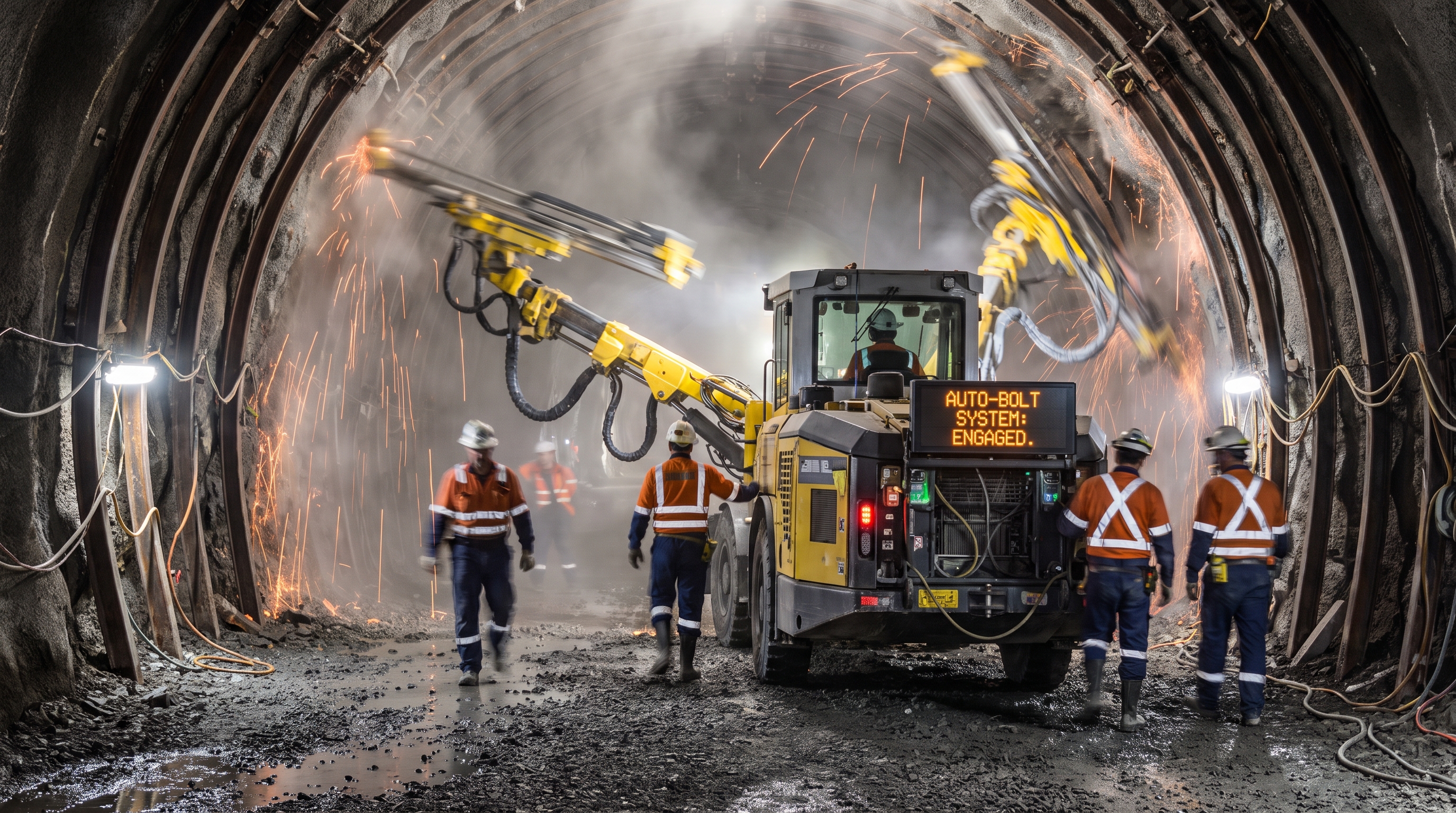
A design that cannot be installed consistently is not a robust design. Check rig reach, headroom, bar length, water and grout access, hole-cleaning method, torque or insertion capacity, resin handling, ventilation, dust control, and safe positioning. Mechanized installation can reduce exposure at the face, but it still depends on trained operators and maintained equipment.
For tunnels, shafts, and similar underground construction, the OSHA underground-construction standard covers hazard instruction, air monitoring, ventilation, communications, mechanical equipment, PPE, fire prevention, and emergency procedures. Project rules and local law may be stricter.
Service life also changes the specification. Review steel loss, coatings, encapsulation, grout cover, groundwater chemistry, damage during installation, exposed threads, couplers, plates, nuts, and the ability to inspect or replace components. Avoid assigning permanent-duty performance to a temporary-support product without documented approval.
8. Verify the selected rock bolt types
Write acceptance criteria before installation. Depending on the system and project, verification may include hole-diameter checks, torque or insertion-pressure records, resin timing, grout tests, pull tests, displacement monitoring, visual inspections, or instrumented trials. Test frequency and corrective action should reflect ground variability and the consequences of failure.
The USACE Rock Reinforcement manual brings design, construction, testing, and performance monitoring together. Use that systems view: a strong bar cannot compensate for poor anchorage, a weak plate, missing surface support, or undocumented installation.
Rock bolt selection checklist
- Map the controlling geology, discontinuities, stress, water, and expected deformation.
- Define whether the support must clamp, suspend, key, retain, or yield.
- Separate local rock reinforcement from prestressed structural anchoring.
- Check installation access, equipment, cycle, and worker exposure.
- Specify the complete bar, anchorage, plate, nut, grout or resin, and surface system.
- Design corrosion protection for the actual service life and environment.
- Complete trials and testing against prewritten acceptance criteria.
- Review field records and adapt only through the approved ground-control process.
Frequently asked questions
Which rock bolt type gives immediate support?
Mechanical expansion and friction systems can develop support during installation, while some resin systems use a fast-setting anchorage portion. “Immediate” does not mean “automatically adequate”; capacity still depends on the ground, hole, installation, and approved design.
Are fully grouted bolts active or passive?
They are often installed without substantial prestress and mobilize load as the ground moves, but configurations vary. Some systems combine point anchorage, tensioning, and later encapsulation. Define the actual installation sequence instead of relying on one label.
Can rock bolts replace permanent ground anchors?
Only if a qualified design shows that the proposed system meets the same load path, movement, durability, test, and regulatory requirements. A short local reinforcement bolt is not a default substitute for a prestressed anchor with a designed free and fixed length.
What is the best rock bolt type for collapsing ground?
A self-drilling hollow bar is often considered because it avoids relying on an open, unsupported borehole. Even so, the designer must verify the bit, grout, bond resistance, corrosion protection, facing, and test plan for the actual site.
For product matching after the engineering basis is defined, review Yongduo’s rock bolt range or send the technical team your drawings and specification.